2025Abhee & AarnaConcept
Proactive Disruption Management
Role
Timeline
Team
TL;DR
Travel doesn't break in isolation. It breaks in chains. What we designed was a way to understand and intervene in those chains
Travel disruptions are a universal pain point — a delayed flight, a missed hotel check-in, or a chain reaction of missed activities all cause high stress. The proactive disruption management system understands your complete itinerary, detects cascading effects in real time, and gives you distinct, clear paths forward before panic sets in.
P.S. — To complete the concept as a prototype, Claude Code was used. Claude Design also helped early renditions of internal screens.
Let me show you the full picture
Disruptions have become a norm today.
Millions of travellers each year face disruptions of some kind or the other and every solution aimed at them only alerts you, without solving for anything real.
The moment it clicked




Problem
Too many platforms. Too little support. No clarity when it matters most
Travellers today juggle multiple booking platforms, emails, customer-service contacts, and loosely integrated apps. Services like Flighty, FlightRadar, and Ixigo do a decent job of surfacing live transport data — but they don't help when disruptions affect a chain of events: transport delays causing missed hotel check-ins, booked experiences, or connecting trips.
Product definition
A unified travel disruption layer
A unified travel disruption management system, powered by an AI assistant that understands cascading travel chaos and intervenes with timely, contextual nudges. The system works because it holds the full itinerary as a connected graph, not just individual bookings — it connects across transport and booking layers (flights, trains, accommodations, experiences, and concierge touchpoints) to offer dynamic, situation-aware next steps when disruptions unfold.
Design processV1
Designing for clarity in chaos
I started with simple widgets that prioritised clarity through a conversational assistant supported by action-first cards. Cards followed a clear hierarchy:
1. The immediate travel item (flight/train/stay, etc.)
2. Associated items affected by it
3. Any other related items


Feedback:
Frequent business travellers were especially interested — cards reduced effort and stress: no more hunting through emails or scrambling for helplines.
Feedback:
A key reviewer noted "the layout felt like everything was equally urgent" — a key trigger for reconsidering the information hierarchy.
Every traveler thinks differently. One disruption, many ways forward
Design processV2
Designing for nonlinear realities.
We reframed travel not as a rigid timeline but as a series of branching paths. Inspired by Black Mirror's multiple endings and video-game logic trees, we built a system that adapts to different disruption responses; because no two travellers navigate chaos the same way.
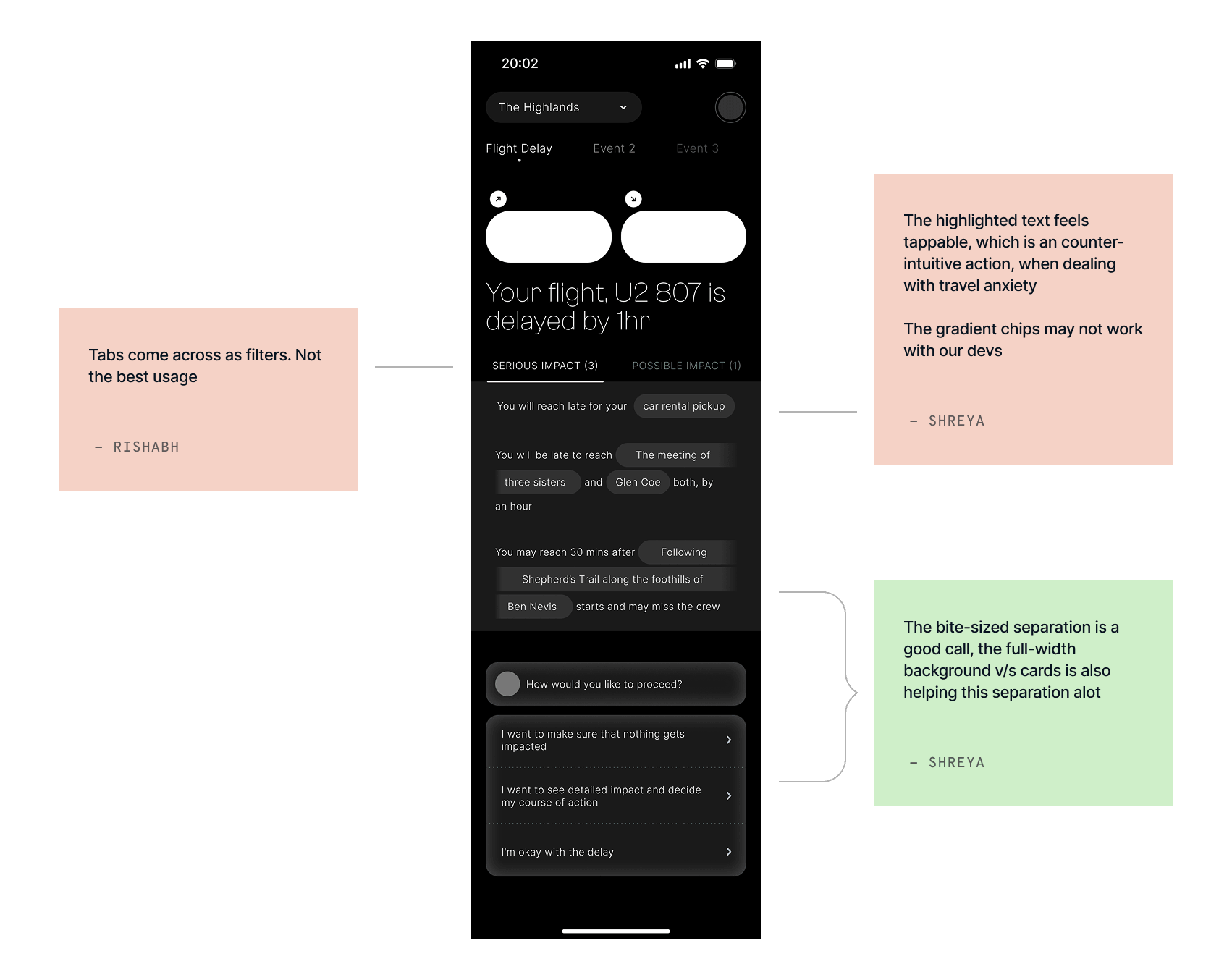
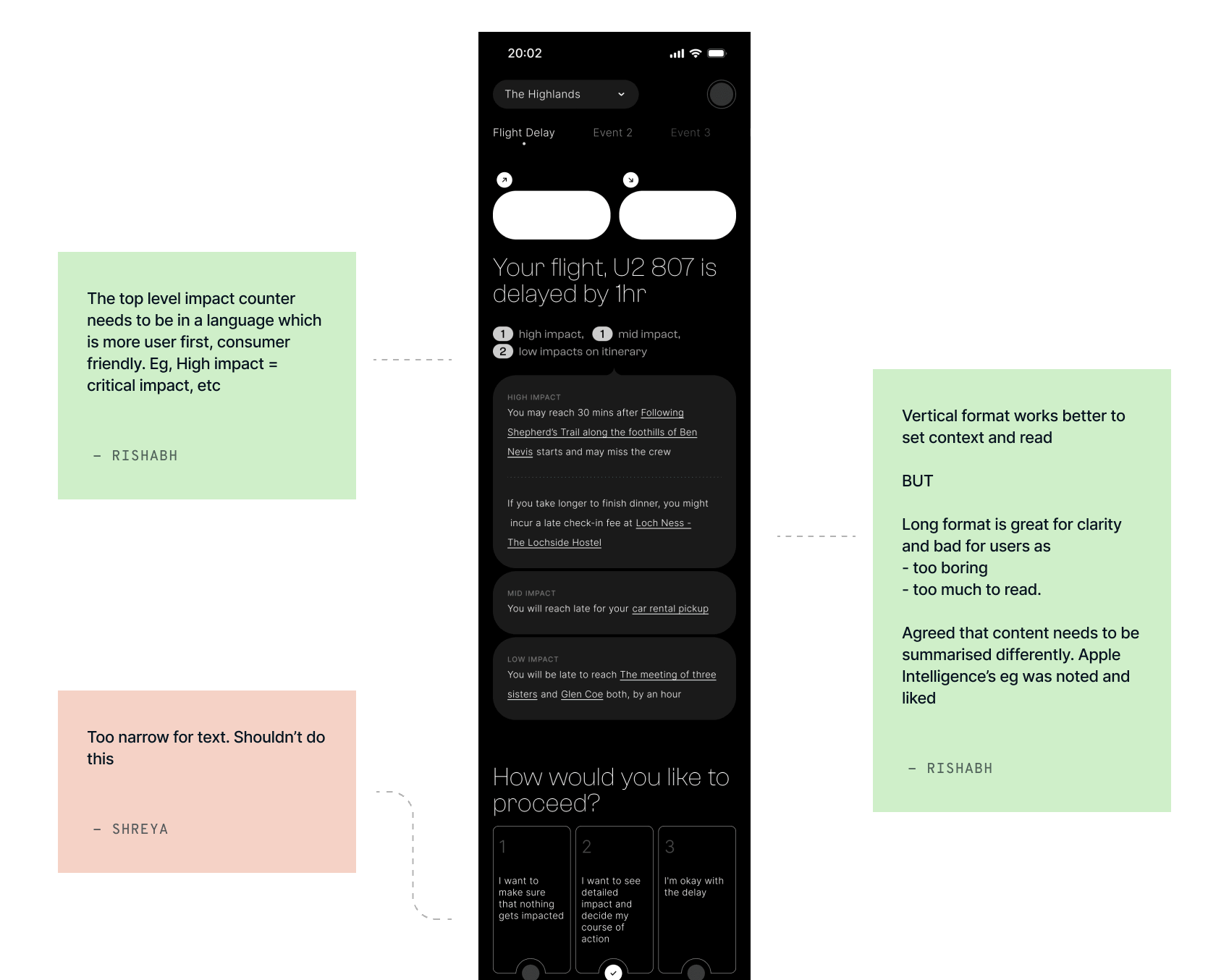
Using real data from my Scotland trip, helped in thinking of possible solutions with real variables.

Internal testing wireframes helped make quick calls and point out quick-small wins.
Frameworks applied
Narrative UX
Building coherence through contextual storytelling.
Second-order Systems Thinking
Visualizing the ripple effects of disruptions.
Choice Architecture
Surfacing the most likely actions first.
Progressive Disclosure
Revealing deeper context only when needed.
Outcome
Reducing cognitive load for high-stress moments
The Disruption Summary became the core interaction model for the product. It was designed to answer three questions in order: what changed, what is now at risk, what to do next.
1. Calling out the main disruption detail in simple language

2. Impact severity takes the pressure off

3. Claude design for quick iterations



Some outcomes aren't measured by metrics — but by the absence of panic, confusion, or chaos.
Reflection
Early reactions validated the need and interest around something like this
This project never launched, so results are speculative — but early stakeholder walkthroughs showed strong alignment:
- Emotional comfort in seeing multiple valid paths, not one forced resolution.
- Likely reduced OTA-helpline dependence — an estimated 2–3 fewer calls per disruption.
- Second-order impacts shown upfront replaced roughly 10–15 minutes of app-hopping.
↱ Forwarded
I showed it to a colleague that really likes to travel and she LOVED IT. She said and I quote, "Why isn't anyone making this come true! Its so useful."
↱ Forwarded
Its so well thought off
↱ Forwarded
This is great because its fully integrated instead of going individually through different apps so it saves lots of hassle and planning more seamless. I would love to have something like this as a little travel buddy. I get all these timings individually separate from each other so this is just making life easier.
↱ Forwarded
I LOVE it!
↱ Forwarded
Bro, I will PAY
↱ Forwarded
Is this real? Can you share the link to download this app?
↱ Forwarded
I will pay for this, I kid you not!
↱ Forwarded
I showed it to a colleague that really likes to travel and she LOVED IT. She said and I quote, "Why isn't anyone making this come true! Its so useful."
↱ Forwarded
Its so well thought off
↱ Forwarded
This is great because its fully integrated instead of going individually through different apps so it saves lots of hassle and planning more seamless. I would love to have something like this as a little travel buddy. I get all these timings individually separate from each other so this is just making life easier.
↱ Forwarded
I LOVE it!
↱ Forwarded
Bro, I will PAY
↱ Forwarded
Is this real? Can you share the link to download this app?
↱ Forwarded
I will pay for this, I kid you not!
What's next?
Beyond Travel: A Broader Use Case
Cascading delays create the same paralysis in healthcare, logistics, and public services — the assistant concept could extend to emergency response, hospital triage, or smart-city alerts.
Disruption isn't just a travel issue—it's a systems problem waiting for better design.